

Why Enterprise Software Projects Fail: A Comprehensive Guide
Unraveling the complexities and pitfalls that lead to enterprise software project failures.
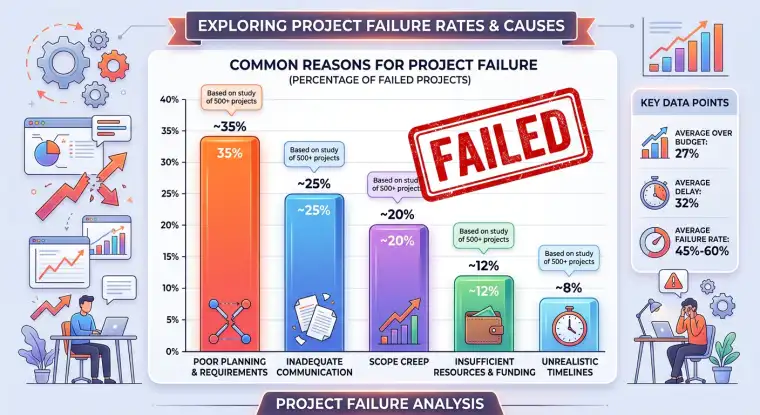
Enterprise software projects are often ambitious and complex. They can fail despite careful planning. Failure can cost millions and hurt business operations.
Understanding the common causes of these failures is the first step. You can then build successful software solutions that drive growth and innovation.
This guide will explore why enterprise software projects fail. It offers insights and strategies to help you improve your project's chances of success.
Enterprise software projects are critical for large companies. When these projects fail, the results can be bad. This can lead to money losses, damage to reputation, and problems with operations. Many things cause project failures. These include bad planning and execution, not enough stakeholder involvement, and changing business needs. This article explains why enterprise software projects fail. It gives you insights to help you deal with these challenges.
This guide will explore the main reasons for enterprise software project failures. It provides strategies to help companies avoid common problems and succeed.
Quick navigation
Poor Requirements Gathering and Management
One of the most common causes of enterprise software project failure is bad requirements gathering and management. You must define the exact needs of the business. This is the foundation of the project. If these requirements are not clear, are confusing, or are missing information, the project will have problems. This can cause big issues during development, testing, and deployment.
Are the project's requirements clearly written and understood by everyone involved? Without clear requirements, the development team does not know what to build. Stakeholders may have different ideas, leading to misunderstandings and disagreements. Without a way to measure success, the project can quickly go wrong.
To reduce these risks, companies should invest in good requirements gathering processes. This includes:
- Involving all stakeholders in gathering requirements.
- Writing requirements clearly and completely.
- Ranking requirements based on business value.
- Regularly reviewing and updating requirements throughout the project.
Inadequate Project Planning
Good project planning is key to the success of any enterprise software project. Without a good plan, projects often lack the structure, resources, and timelines they need. Bad planning can show up in many ways, from unrealistic deadlines to not enough money. Also, bad risk management can make a project vulnerable to problems.
Did the project team check all potential risks and create plans to deal with them? Good project planning includes making a detailed project schedule, allocating resources, and creating risk management plans. Without this preparation, projects often have delays, go over budget, and have quality issues.
To improve project planning, consider these strategies:
- Create a detailed project plan that shows the scope, schedule, and budget.
- Identify and assess project risks. Develop plans to deal with them.
- Allocate enough resources, including people, money, and tools.
- Regularly check project progress and make changes as needed.
Lack of Stakeholder Involvement
The success of an enterprise software project is directly linked to stakeholder involvement. Stakeholders include anyone with an interest in the project's outcome. This includes end-users, business leaders, IT staff, and project managers. Without their help and feedback, projects often fail to meet business needs. This leads to low adoption rates and lower ROI. Also, bad communication can lead to misunderstandings, conflicts, and a lack of support.
Are stakeholders actively involved throughout the project? You need regular communication, feedback sessions, and chances to work together. Without enough stakeholder involvement, projects may not meet business goals. This can cause big problems.
Here’s how to improve stakeholder engagement:
- Identify all stakeholders. Understand their needs and expectations.
- Set up clear ways to communicate and how often.
- Involve stakeholders in making decisions.
- Provide regular updates on project progress.
Insufficient Testing and Quality Assurance
Testing and quality assurance (QA) are essential for making sure software meets the required standards. Not enough testing can result in buggy software. This can have big consequences for the business. This includes problems with operations, security risks, and damage to reputation. Ignoring QA can also result in costly rework and delays.
Has the project implemented complete testing processes, including unit testing, integration testing, and user acceptance testing? Thorough testing is key to finding and fixing issues before deployment. Without enough testing, the software may not work correctly, and the business may suffer.
To improve testing and quality assurance:
- Create a complete testing plan.
- Do thorough testing throughout the project.
- Involve end-users in user acceptance testing.
- Address and fix all identified issues quickly.
Scope Creep and Feature Bloat
Scope creep means changes to a project's scope after it has started. Feature bloat means adding unnecessary or complex features. Both can greatly impact a project's success. As the scope grows, projects can quickly become hard to manage, go over budget, and be delayed. Unnecessary features can also confuse users and make the software harder to use.
Is the project scope well-defined and managed? To avoid these issues, you must set and keep a clear project scope. Changes should be carefully evaluated. New features should be prioritized based on their business value.
To fight scope creep and feature bloat:
- Define a clear project scope and stick to it.
- Set up a change management process.
- Prioritize features based on business value.
- Regularly review and re-evaluate project scope.
Technology and Integration Challenges
Enterprise software projects often involve integrating new systems with old ones. This can cause big technical problems, especially with complex or outdated infrastructure. Technology challenges can also come from choosing the wrong technologies or using them incorrectly. This can cause integration problems, performance issues, and security risks.
Does the project team have the skills to handle these challenges? Choosing the right technology and making sure it integrates well are key to success. Without these, projects can face serious difficulties.
Here are some ways to address these challenges:
- Do thorough research and analysis before choosing technologies.
- Make sure the project team has the necessary skills.
- Create a detailed integration plan.
- Regularly test and monitor the system.
What this means for you
Understanding why enterprise software projects fail is not just about avoiding problems. It is about building success. When you know the common problems, you can take steps to prevent them. You can increase your chances of successfully delivering valuable software solutions by focusing on clear requirements, complete planning, stakeholder engagement, thorough testing, and effective scope management. This information lets you make smart decisions throughout the project. You can make sure the software meets your business needs.
By taking a proactive approach, you can:
- Reduce project risks and improve the chances of success.
- Make sure your software meets business needs.
- Get the best return on investment (ROI) for your software projects.
- Improve the overall efficiency and effectiveness of your business.
Risks, trade-offs, and blind spots
Every software project has risks. Ignoring these risks can lead to unexpected problems. The potential impact of failure can be significant. The risks with enterprise software projects are varied. They include:
- Inadequate resource allocation: Not allocating enough resources, including money, people, and time, can cause project delays and cost overruns.
- Technical debt: Accumulating technical debt, often due to rushed development, can cause long-term maintenance issues, lower performance, and higher costs.
- Security vulnerabilities: Weak security measures can lead to data breaches. This can result in money losses, damage to reputation, and legal issues.
- Lack of user adoption: If the software does not meet user needs or is hard to use, users may not adopt it. This defeats the project's purpose.
- Vendor lock-in: Relying on one vendor for software and services can limit flexibility and increase costs.
Successfully dealing with these risks requires careful planning, risk management, and the ability to adapt. It is also important to carefully consider the trade-offs. For example, choosing a cheaper solution may save money. However, it may not perfectly meet the business's needs. Implementing a highly customized solution may offer more features. However, it may also be more expensive and take longer to deploy. Knowing the potential trade-offs is essential for making smart decisions.
Main points
Enterprise software projects are important for large organizations. However, they are often complex and likely to fail. Companies can greatly increase their chances of success by understanding the common reasons for project failures and using proactive strategies. It is important to learn from past failures and use the best practices for project success.
- Poor Requirements Management: Not defining and documenting requirements well.
- Insufficient Planning: Lacking detailed project plans, risk assessment, and resource allocation.
- Lack of Stakeholder Involvement: Not enough communication and feedback from stakeholders.
- Inadequate Testing: Not enough testing and quality assurance processes.
- Scope Creep: Uncontrolled changes to the project scope after it starts.
- Technology Challenges: Difficulties with technology selection and integration.
- Poor Communication: Bad communication between stakeholders and the development team.
- Lack of Executive Support: Without executive support, projects can be under-resourced or have unclear priorities.
By focusing on these key areas, companies can improve their project results and create more business value. By learning from common project failures and following industry best practices, your organization can improve its software project delivery.