

Why Weak Product Pages Can Kill Your eCommerce Sales
Uncover the design flaws that drive customers away and the strategies to fix them.
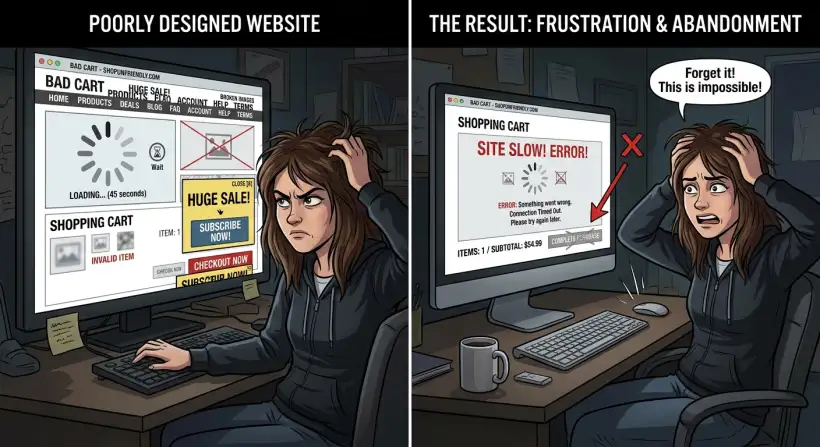
Have you ever landed on a product page and instantly clicked away? You're not alone. Poor design choices are costing businesses valuable sales every day.
From confusing layouts to missing information, the smallest details can make or break a conversion. Understanding these pitfalls is the first step towards increasing your profits.
Let's look closely at product page optimization. Discover how to change your website from a passive storefront into a strong sales machine.
In the competitive world of e-commerce, every click matters. Your product pages often create the first impression of your brand. A well-designed product page can turn a casual browser into a loyal customer. A poorly designed one can send them to your competitors. This guide explores the important parts of product page design. It shows how these parts affect your sales. You will see common design mistakes, customer frustrations, and solutions to help you optimize your product pages for the most conversions.
Are you ready to learn why weak product pages can hurt your e-commerce business?
Quick navigation
The Anatomy of a High-Converting Product Page
A high-converting product page is more than a place to show a product. It is a carefully made sales tool. It guides the customer toward a purchase. This starts with a clear, high-quality product image that gets attention. Then comes a short and informative product title and description that highlights key features and benefits.
How do you make sure your product pages have all the needed parts?
Important parts include:
- High-Quality Images and Videos: Show your product from different angles with clear, professional visuals.
- Compelling Product Title and Description: Use words to highlight benefits, not just features.
- Clear Pricing and Call to Action: Make prices easy to find and the "Add to Cart" button obvious.
- Customer Reviews and Ratings: Build trust by showing social proof.
- Detailed Specifications and Information: Give all details needed for buying.
- Easy Navigation and Search: Help customers find what they want quickly.
What this means for you
For e-commerce businesses, a well-designed product page has a big impact. It directly affects how many people buy, customer satisfaction, and revenue. A product page is often the place where a potential customer decides to buy. By optimizing this, businesses can improve their sales and build better customer relationships.
Do you know how to build stronger customer relationships through page design?
Here are some key benefits:
- Increased Conversion Rates: Optimized pages help customers buy efficiently.
- Higher Average Order Value: Cross-selling and upselling on product pages increase revenue.
- Reduced Bounce Rates: Engaging content and easy navigation keep customers on the site longer.
- Improved Customer Loyalty: Positive experiences lead to repeat purchases and brand advocacy.
Common Design Mistakes That Kill Sales
Some common design mistakes can hurt a product page's effectiveness and cause lost sales. These mistakes come from not understanding customer behavior and not focusing on user experience. Fixing these issues is important for any e-commerce business that wants to succeed.
Can you see the design mistakes that are hurting your sales?
- Poor Quality Images: Blurry or low-resolution images do not show products well.
- Inadequate Product Descriptions: Vague descriptions leave customers without information.
- Confusing Navigation: Pages that are hard to navigate frustrate users and increase bounce rates.
- Lack of Social Proof: No reviews and ratings reduce trust.
- Hidden Pricing and Shipping Costs: Lack of transparency leads to abandoned carts.
- Unclear Call-to-Action (CTA): Buttons that are not visible or appealing fail to convert.
Understanding Customer Frustrations
Online shoppers often face frustrations that stop them from buying. These frustrations show where product pages can improve to create a better shopping experience. Understanding and addressing these issues is key to increasing sales.
Have you thought about what your customers find frustrating?
Major issues include:
- Lack of Information: Customers need detailed product details and how to use them.
- Slow Loading Times: Slow pages frustrate users and reduce engagement.
- Poor Mobile Optimization: Pages that do not work well on phones lose traffic.
- Difficult Checkout Processes: Complex checkout forms lead to abandoned carts.
- Lack of Customer Support: Not being able to quickly find answers or contact support.
The Power of Compelling Product Descriptions
A compelling product description is important for getting potential customers to buy. It is more than a list of features. It is a persuasive story that highlights the benefits and value of the product.
How can you write a product description that turns browsers into buyers?
- Focus on Benefits: Emphasize how the product solves a problem or improves the customer's life.
- Use Persuasive Language: Use words that create excitement and urgency.
- Tell a Story: Engage customers emotionally by telling a story about the product.
- Include Keywords: Optimize descriptions for search engines to increase visibility. SEO best practices can help you improve your page rank.
- Keep it Concise: Get to the point quickly, avoiding unnecessary jargon.
Risks, trade-offs, and blind spots
Optimizing product pages can increase sales. But there are potential problems and areas that need careful thought. Businesses must consider these risks and blind spots to make good decisions and create effective product pages. If you are not careful, you may face the following risks:
Are you aware of the challenges and drawbacks of product page optimization?
- Over-Optimization: Using too many keywords can lead to penalties from search engines.
- Image Quality and Loading Speed: High-resolution images can slow down page loading times.
- Customer Expectations: Setting expectations that are not realistic can lead to customer dissatisfaction.
- Cost: Paying for high-quality images, videos, and copywriting may be expensive.
- Testing and Iteration: Optimizing product pages requires continuous testing and changes.
Main points
Optimizing product pages is important for e-commerce success. But the process has its challenges. By fixing common design mistakes, understanding customer frustrations, and focusing on compelling product descriptions, businesses can improve their conversion rates and revenue.
- Prioritize High-Quality Visuals: Use clear, professional images and videos to show your products.
- Craft Compelling Descriptions: Focus on benefits and use persuasive language to attract customers.
- Ensure Easy Navigation: Make it easy for customers to find information and buy.
- Build Trust with Social Proof: Show customer reviews and ratings.
- Optimize for Mobile: Make sure your product pages work well on all devices.
- Offer Clear Pricing and CTAs: Make prices clear and the "Add to Cart" button obvious.
- Test and Iterate: Test and improve your product pages for the best performance.
- Provide Excellent Customer Support: Make sure customers can easily get answers to their questions.
Use these strategies to create product pages that attract customers, increase sales, and build a successful e-commerce business. Need more help? Start with understanding the SEO fundamentals.