
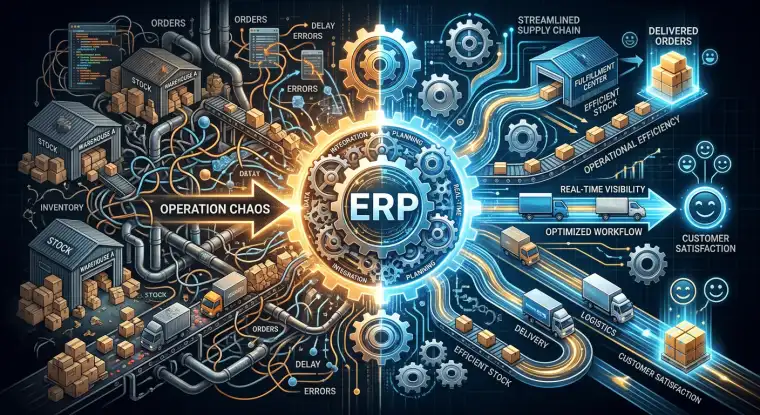
ERP Systems: Boosting Operational Efficiency for E-commerce Businesses
A Comparative Guide to Selecting the Right ERP Solution
Are you tired of juggling multiple software platforms and spreadsheets to manage your e-commerce business?
Imagine a single, integrated system that streamlines your operations, from inventory management to order fulfillment.
This guide helps you explore ERP systems, comparing features, and pinpointing the best solutions for your e-commerce needs.
In today's quick e-commerce environment, operational efficiency is important. As businesses grow, managing inventory, sales, customer relationship management (CRM), and financial accounting becomes complex. Enterprise Resource Planning (ERP) systems offer a complete solution. They combine all these functions into one platform. This guide explores how ERP systems can transform your e-commerce business. It provides information about their benefits, the best systems, and how to choose the right one for your needs.
By using an ERP system, e-commerce businesses can be more efficient, reduce costs, and increase profits. Understanding the value of an ERP system is essential for long-term success, whether you are a small startup or a large company. Let's look at why ERP systems are important.
Quick navigation
What this means for you
An ERP system combines various business functions, giving a central view of all operations. This streamlines workflows, reduces data errors, and improves decision-making. For e-commerce businesses, this means several key benefits.
One primary advantage is improved inventory management. ERP systems provide real-time stock levels. This helps prevent running out of stock and overstocking. You can meet customer demand efficiently while keeping storage costs low. ERP systems also automate order processing, from order placement to shipping. This automation reduces manual effort and speeds up fulfillment, increasing customer satisfaction.
Furthermore, ERP systems improve customer relationship management. By including CRM, businesses can track customer interactions, manage sales, and personalize marketing. This results in better customer service, more customer retention, and more sales. Finally, ERP systems improve financial management by automating accounting, providing accurate financial reports, and helping with cash flow. This helps businesses make informed financial decisions and ensures they follow regulations.
ERP Systems: Key Features and Benefits
ERP systems offer many features designed to streamline business processes and improve efficiency. These features are usually in different modules, each for a specific function. Here is an overview of the most important ones:
Inventory Management: This module provides real-time tracking of inventory levels, automated reordering, and warehouse management. It helps businesses optimize inventory levels, reduce costs, and prevent running out of stock.
Order Management: This module automates the order-to-cash process, from order placement to fulfillment and shipping. It ensures accurate order processing, faster fulfillment, and better customer satisfaction.
CRM: Integrates customer data, manages sales, and personalizes marketing. This module helps businesses improve customer service, increase customer retention, and increase sales.
Financial Management: This module automates accounting, provides accurate financial reporting, and helps with cash flow. It helps businesses make informed financial decisions and ensures they follow regulations.
Supply Chain Management: This module manages the flow of goods and services from suppliers to customers. It helps businesses optimize their supply chain, reduce costs, and improve delivery times.
Reporting and Analytics: Provides real-time data and insights into business performance. It allows businesses to make data-driven decisions and find areas for improvement. Do you want to make more data driven decisions?
Popular ERP Systems for E-commerce
Several ERP systems are available for e-commerce businesses. Each has its strengths and weaknesses. Choosing the right one depends on your needs, budget, and business size. Here is a look at some of the most popular options:
SAP Business One: A complete ERP solution for small and medium-sized businesses. It has modules for finance, sales, purchasing, inventory management, and CRM. SAP Business One is known for its scalability and integration capabilities. This makes it a popular choice for growing e-commerce businesses.
Oracle NetSuite: A cloud-based ERP system for businesses of all sizes. It offers many modules, including finance, CRM, e-commerce, and supply chain management. NetSuite is highly customizable and provides strong reporting and analytics.
Microsoft Dynamics 365: A set of cloud-based business applications. It includes ERP and CRM. Dynamics 365 has modules for finance, operations, sales, marketing, and customer service. It works well with other Microsoft products. This makes it a good choice for businesses already using Microsoft.
Zoho CRM: A cloud-based CRM system that works with several ERP solutions. Zoho CRM is easy to use, affordable, and has many customization options. This makes it a good fit for businesses of any size.
Odoo: An open-source ERP system with many modules, including e-commerce, CRM, inventory management, and accounting. Odoo is highly customizable and has a flexible pricing model. This makes it popular for businesses with specific needs or limited budgets.
Comparing ERP Systems: Key Considerations
Selecting the right ERP system requires careful consideration of different factors. Evaluating these aspects helps you make an informed decision and choose a system that meets your business goals.
Features and Functionality: Consider the specific features and modules offered by each system. Make sure the system includes all the features you need, like inventory management, order processing, CRM, and financial reporting. Prioritize the features most important to your e-commerce operations.
Scalability: Choose an ERP system that can grow with your business. As your e-commerce business grows, your ERP system should handle more transactions, data, and users. Look for systems that offer cloud-based or on-premise solutions.
Integration Capabilities: Check how well the system integrates with your e-commerce platforms, payment gateways, shipping providers, and other applications. Seamless integration reduces data silos and streamlines workflows. Consider whether the system offers pre-built integrations or APIs for custom integrations.
Ease of Use: The ERP system should be easy to use and navigate. Consider the system's interface, training materials, and technical support. A user-friendly system reduces training time and increases user adoption.
Cost: Evaluate the total cost, including the initial implementation costs, subscription fees, and any extra costs for customization or support. Compare pricing models, such as per-user fees or subscription tiers, and choose the option that fits your budget.
Implementation Time: Consider the time it will take to implement the ERP system. Implementation times vary based on the system's complexity and your business size. Choose a system that can be implemented quickly to avoid disrupting your operations.
Vendor Reputation and Support: Research the vendor's reputation and customer reviews. Look for vendors with a strong record of providing reliable products and excellent customer support. Consider the availability of training, documentation, and technical support.
ERP System Integration
ERP system integration is important for ensuring data flows smoothly across all your business functions. Proper integration reduces manual data entry, reduces errors, and improves efficiency.
E-commerce Platform Integration: The ERP system should integrate smoothly with your e-commerce platform (e.g., Shopify, Magento, WooCommerce). This integration allows real-time data synchronization, like product information, order details, and customer data. Integration lets you manage your online store and back-end operations from a single system.
Payment Gateway Integration: Integrate your ERP system with your payment gateways (e.g., PayPal, Stripe) to automate payment processing and reconciliation. This integration streamlines financial transactions, reduces manual effort, and improves accuracy.
Shipping Provider Integration: Integrate your ERP system with your shipping providers (e.g., FedEx, UPS, DHL) to automate shipping label generation, track shipments, and manage shipping costs. Integration improves order fulfillment times and increases customer satisfaction.
CRM Integration: Integrate your ERP system with your CRM system to synchronize customer data, sales, and marketing. Integration lets you provide personalized customer service, track customer interactions, and improve sales performance.
API and Custom Integration: ERP systems often have APIs (Application Programming Interfaces). You can use these to customize integrations with other applications or systems. Custom integrations allow you to tailor the system to your business needs. However, the best ERP systems often have pre-built integrations, which could make your life easier.
Risks, trade-offs, and blind spots
While ERP systems offer significant benefits, there are risks, trade-offs, and blind spots to be aware of before implementation.
Implementation Complexity: Implementing an ERP system can be complex and take time. It requires resources and expertise. Poor planning or execution can cause delays, cost overruns, and system failures. Careful planning, project management, and a phased implementation can reduce these risks.
Cost: ERP systems can be expensive. They have high upfront costs for software licenses, implementation services, and ongoing maintenance. Consider the total cost, including direct and indirect costs, and factor in the return on investment before deciding.
Data Migration Challenges: Moving data from existing systems to a new ERP system can be difficult. Data quality issues, data loss, and integration errors can disrupt operations. Develop a comprehensive data migration strategy, including data cleansing, validation, and testing, to reduce these risks.
User Adoption: Resistance to change from employees can hinder user adoption. If employees are reluctant to use the new system, it will fail. Involve users in the implementation, provide training and support, and communicate the new system's benefits to encourage user adoption.
Security Vulnerabilities: ERP systems store sensitive data, making them targets for cyberattacks. Implement strong security measures, including data encryption, access controls, and regular security audits, to protect your data.
Main points
ERP systems are essential for optimizing operational efficiency in e-commerce businesses. Here are key takeaways:
- ERP systems combine various business functions, giving a central view of all operations.
- Key benefits include improved inventory management, automated order processing, and better customer relationship management.
- Popular ERP systems include SAP Business One, Oracle NetSuite, Microsoft Dynamics 365, Zoho CRM, and Odoo.
- Carefully consider features, scalability, integration capabilities, ease of use, cost, implementation time, and vendor reputation.
- ERP system integration with e-commerce platforms, payment gateways, and shipping providers is essential for streamlining operations.
- Be aware of potential risks, like implementation complexity, data migration challenges, and security vulnerabilities.
- To improve your e-commerce business, consider integrating ERP with your marketing automation efforts by using tools like those provided by Performance Max.
- Also, you can learn how to boost your sales using TikTok Shop Ads.
- Finally, improve customer lifetime value with the best retargeting strategies.
Choosing and implementing the right ERP system is a big investment. The rewards—more efficiency, lower costs, and better customer satisfaction—make it worthwhile for any e-commerce business that wants to succeed in a competitive market.