

How to Do Keyword Research: A Beginner's Step-by-Step Guide
Discover the secrets of effective SEO with our complete keyword research guide.
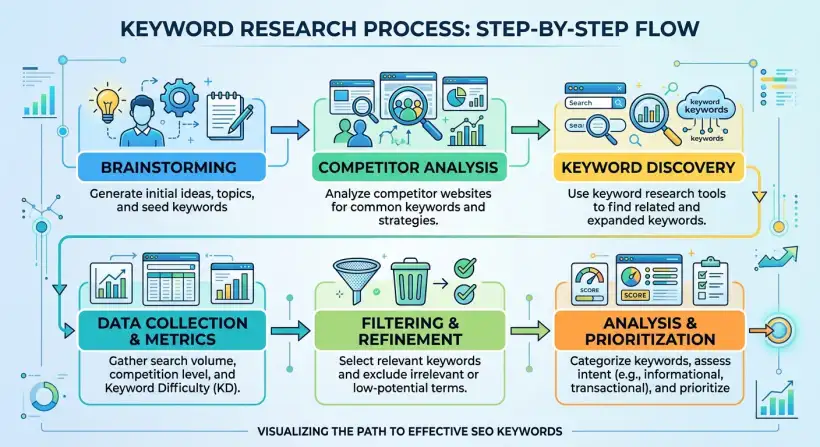
Do you want to improve your online presence? Keyword research is key to guiding your content to the right people.
Finding the best keywords can make your content seen, instead of being lost.
This guide shows you, step by step, how to do keyword research to rank higher.
In digital marketing, knowing how to do keyword research is essential. This process finds the terms people use to search for information, products, or services related to your business. Keyword research lets you optimize your content. This makes sure it reaches the right audience and improves your search engine rankings. This guide is a step-by-step tutorial for beginners. You will learn and apply effective keyword research strategies. We will cover the basics, provide methods, and discuss how keyword research works on blogs, YouTube, and Google Ads.
Quick navigation
Understanding the Basics of Keyword Research
Before you learn how, you need to know why. Keyword research is the foundation of any successful SEO strategy. It is finding and analyzing the words and phrases people use when searching online. These keywords can then be added to your content. This improves your visibility in search engine results. This process helps you understand your target audience's needs and search behaviors. Effective keyword research lets you create content that ranks well and connects with your audience. This drives more traffic and conversions.
Think about the goal behind a search. Is the user looking to learn something? Do they want to buy something? Are they comparing options? Understanding search intent is critical. This knowledge lets you tailor your content to match what users are looking for.
Step-by-Step: The Keyword Research Process
Let's break the process into steps. Start with a clear understanding of your niche and target audience. Without this, you are working blindly.
Step 1: Define Your Niche and Audience
What is your business about? Who are you trying to reach? Create detailed profiles of your ideal customers. Include their demographics, interests, and problems. This step will help you focus your keyword research. It makes sure your content matches your audience’s needs.
Step 2: Brainstorm Initial Keyword Ideas
Think about the topics and questions related to your niche. What would your audience search for? Use your knowledge to create a list of potential keywords. Don’t worry about volume or competition at this stage. This is a brainstorming exercise to get you started.
Step 3: Use Keyword Research Tools
Use tools like Google Keyword Planner, SEMrush, Ahrefs, or Moz Keyword Explorer to expand your list. Enter your initial keywords and explore related terms, search volumes, and competition levels. These tools give you data that helps you understand which keywords have the most potential.
Step 4: Analyze Keyword Metrics
Pay close attention to search volume (the average number of searches per month), keyword difficulty (how hard it is to rank), and the intent behind the keywords. Choose keywords with a good balance of search volume and low to moderate competition. High-volume keywords are tempting. If they are highly competitive, they might not be achievable for a beginner.
Step 5: Group and Categorize Keywords
Organize your keywords into groups or categories. This structure helps you plan your content strategy. Think about grouping by topic, user intent, or product/service type. This organization is essential for creating a content plan.
Step 6: Prioritize Your Keywords
Not all keywords are equal. Focus on keywords that match your business goals and have a high potential for conversions. Start with keywords that are relevant, have good search volume, and are within your reach in terms of competition. Don’t try to target everything at once. Start with what is easy.
Step 7: Implement Keywords in Your Content
Add your chosen keywords naturally to your content. Include them in your page titles, headings, body text, image alt tags, and meta descriptions. Avoid keyword stuffing. This can hurt your search rankings. Write for your audience first. Use keywords to make your content more relevant.
Tools of the Trade: Keyword Research Tools
The right tools can make your keyword research process simpler and better. Several tools offer features from basic keyword suggestions to in-depth competitor analysis.
Google Keyword Planner: This free tool from Google is perfect for beginners. It gives you keyword suggestions and search volume data. It helps you plan your Google Ads campaigns. It is a good starting point for understanding keyword trends.
SEMrush: This is a complete SEO tool that offers keyword research, competitor analysis, site audits, and more. SEMrush gives you detailed information on keyword difficulty, backlink profiles, and content optimization. It is suitable for more advanced users.
Ahrefs: Similar to SEMrush, Ahrefs offers extensive keyword research. It includes competitor analysis, backlink analysis, and content gap analysis. It is a tool for in-depth SEO analysis and strategy development.
Moz Keyword Explorer: Moz offers an easy-to-use keyword explorer that provides keyword suggestions, difficulty scores, and opportunity analysis. It helps you assess the potential of your target keywords and find ranking opportunities.
Choosing the right tool depends on your budget and needs. Free tools like Google Keyword Planner are a good starting point. Paid tools offer more features and data. Consider your long-term goals and choose a tool that fits your strategy.
Keyword Research for Blogs, YouTube, and Google Ads
Keyword research is not the same for every platform. The methods and focus areas change based on the platform you use. Let's see how to change your approach for blogs, YouTube, and Google Ads.
Keyword Research for Blogs:
For blogs, you should focus on creating informative content that answers user questions. Start by finding long-tail keywords (longer, more specific phrases) that match your blog's topics. Research keywords with informational intent and high search volume. Use these keywords in your titles, headings, and body content. This improves your search engine rankings and attracts organic traffic. Use internal linking to guide readers to other articles on your blog. This increases engagement and time on site. The goal is to build authority and provide value to your readers. Search engine optimization is essential for this.
Keyword Research for YouTube:
On YouTube, keyword research involves finding the terms people search for on the platform. Use YouTube's search suggestions, Google Trends, and keyword research tools to find relevant keywords. Include these keywords in your video titles, descriptions, and tags. This helps your videos appear in search results and recommended videos. Consider the video's content, focusing on what viewers want to see. Optimize your video content and descriptions for discoverability to increase views and engagement. This means understanding what people are searching for. Then, create video content to match those queries.
Keyword Research for Google Ads:
In Google Ads, keyword research helps you target specific search terms to drive paid traffic to your website. Use the Google Keyword Planner to find relevant keywords. Also, estimate their search volume and cost-per-click (CPC). Choose keywords with commercial intent (e.g., “buy [product]”) to target users who are ready to buy. Group related keywords into ad groups. Create ad copy that aligns with these keywords. Regularly monitor your campaign performance. Change your keyword targeting and bids to improve your return on investment. The focus is to choose profitable keywords and maximize conversions.
Analyzing and Implementing Your Findings
Once you have your keyword data, you must analyze your findings and create a strategy. This process involves assessing the potential of your keywords. Also, you need to add them effectively to your content and marketing.
Analyze Your Data:
Look at the data from your keyword research tools. Focus on the keywords with the highest search volume, low competition, and relevant intent. Find trends or patterns. Look for chances to create content around related topics. This analysis will guide your content creation and SEO strategy.
Create a Content Calendar:
Make a content calendar that shows the topics and keywords you will target. Plan your blog posts, YouTube videos, and ad campaigns around these keywords. This calendar helps you stay organized and consistent. Plan your publication schedule and promote your content.
Integrate Keywords Naturally:
Add your chosen keywords to your content. Use keywords in your titles, headings, meta descriptions, and body text. Write naturally and avoid keyword stuffing. The goal is to create high-quality, engaging content that also optimizes for search engines.
Track Your Results:
Use tools like Google Analytics and Google Search Console to track your progress. Track your website traffic, keyword rankings, and conversions. Evaluate your performance and change your keyword strategy. Regular monitoring lets you measure your efforts and improve your approach.
What this means for you
Keyword research, when done correctly, can significantly improve your online presence and marketing success. It lets you create better content that reaches your target audience and drives traffic. It gives you a deeper understanding of your audience. This lets you tailor your content to match their needs and interests. Knowing what people search for helps drive conversions, generate leads, and boost sales. It helps improve search engine rankings. This increases visibility and drives more organic traffic to your website. The benefits are many.
The time you spend on keyword research pays off. It increases the relevance of your content. It improves your chances of ranking highly in search engine results. This improved visibility leads to more website traffic, engagement, and higher conversion rates. By understanding your audience's needs and search habits, you can create a content strategy.
Risks, trade-offs, and blind spots
Keyword research is valuable, but it has limits. There are risks and blind spots that you should know about. This makes sure your strategies are effective and sustainable.
Over-reliance on tools: Relying too much on keyword research tools without considering your audience's needs can lead to content that misses the mark. Analyze the data. Also, consider the context and user intent.
Focusing solely on search volume: High-volume keywords are attractive. If they are too competitive, they might be hard to rank for, especially for beginners. It's often better to start with less competitive, more specific keywords.
Keyword stuffing: Forcing keywords into your content can damage your credibility. Write naturally. Avoid the urge to over-optimize your content with keywords. Google can penalize websites that use keyword stuffing.
Ignoring emerging trends: Keyword research is essential. It should not be the only thing driving your content. Consider emerging trends and topics that are relevant to your audience. This helps you stay adaptable and competitive in the digital world.
Main points
- Keyword research is a basic SEO process. It identifies the terms people use when searching online.
- The step-by-step process involves defining your niche and audience, brainstorming ideas, using keyword research tools, analyzing metrics, and prioritizing keywords.
- Tools like Google Keyword Planner, SEMrush, Ahrefs, and Moz Keyword Explorer give you insights for research.
- Keyword research strategies change for blogs, YouTube, and Google Ads. Each needs a different approach.
- Analyzing data, creating a content calendar, and adding keywords naturally are essential for implementation.
- Effective keyword research can improve online visibility, drive traffic, and improve conversion rates.
By following these steps, you can do keyword research. Are you ready to dive deeper into SEO and content creation? Start using these strategies to improve your online presence. Good luck!