

NetSuite vs. Magento: Which Enterprise Platform Is Better?
A comprehensive comparison of ERP and eCommerce solutions.
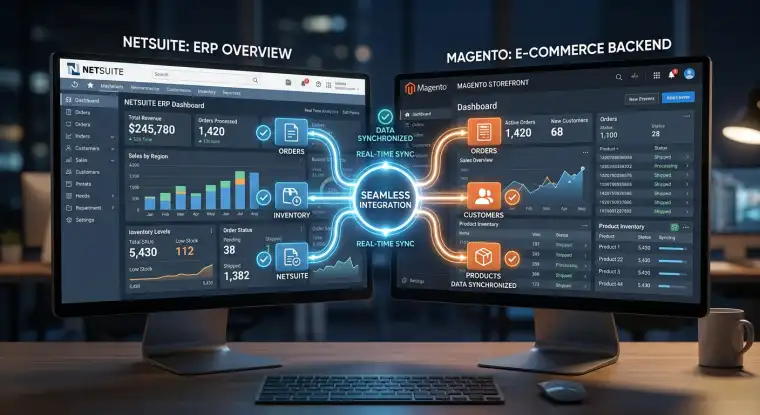
Choosing the right enterprise platform is a big decision. It can affect your business's efficiency and growth.
NetSuite and Magento are strong choices. Each has different strengths for different business needs.
This article compares them head-to-head. It helps you decide which platform fits your business goals.
Businesses often face a choice when planning their enterprise resource planning (ERP) and e-commerce. They must decide which platforms best fit their operational needs. This comparison looks at two leaders: NetSuite, an ERP system, and Magento, an e-commerce platform. Understanding each platform's features, benefits, and limits is key to making a good choice. This guide gives an in-depth look at NetSuite and Magento. It helps you understand the options and choose the right one for your business.
Quick navigation
What is NetSuite?
NetSuite, from Oracle, is a cloud-based ERP system. It combines different business processes. It offers applications for financial management, CRM, and supply chain management. This helps provide a single platform for managing all core business functions. But, what makes NetSuite different from other solutions?
NetSuite is known for its ability to streamline operations across departments. It centralizes data and automates tasks. This helps businesses improve efficiency and reduce errors. The system can also grow with your business. It handles increasing transaction volumes and user numbers.
What is Magento?
Magento, now known as Adobe Commerce, is a leading e-commerce platform. It gives businesses tools to create and manage online stores. Its open-source nature allows for customization and flexibility. What are the key features that make Magento so popular?
Magento is valued for its many features. These include product catalog management, marketing tools, and SEO optimization. It supports many e-commerce business models, from startups to large enterprises. The platform's structure also allows it to handle large amounts of traffic and transactions. This makes it suitable for growing e-commerce businesses. To learn more about e-commerce advertising, read this guide: Performance Max vs. Shopping Ads: Which is Better?
NetSuite vs. Magento: Core Differences
The main difference is their focus. NetSuite is an ERP system. Magento is an e-commerce platform. NetSuite integrates all business functions. Magento excels in e-commerce. How do these differences help a business?
Here are the core differences:
- Functionality: NetSuite focuses on ERP. It integrates all business processes. Magento specializes in e-commerce. It offers online store management.
- Target Audience: NetSuite is for businesses needing ERP solutions. Magento is for businesses focused on e-commerce.
- Integration: NetSuite offers built-in integrations. Magento supports integrations via extensions and APIs.
- Customization: NetSuite offers customization within its framework. Magento offers customization through open-source code.
- Pricing: NetSuite is often priced by modules and user count. Magento has a free open-source version and a paid enterprise version.
What this means for you
The choice between NetSuite and Magento depends on your business's needs and goals. Do you need an all-in-one ERP system? Or is your main goal to create a strong, scalable e-commerce store? How can you decide which platform fits your business?
Choose NetSuite if:
- You need a fully integrated system.
- You need to manage financials, CRM, and supply chain.
- You want a system that grows with your business.
Choose Magento if:
- Your main business is e-commerce.
- You need a customizable online store.
- You need strong SEO and marketing capabilities.
Risks, trade-offs, and blind spots
Each platform has risks and limits. NetSuite can be complex and expensive to implement. Magento needs technical expertise for customization and maintenance. What are some downsides of each platform?
NetSuite Risks:
- High initial costs and ongoing fees.
- Complexity can be hard to learn.
- Customization can be limited compared to open-source solutions.
Magento Risks:
- Needs technical expertise for customization and maintenance.
- Security issues can arise with extensions.
- Performance can be an issue with poorly optimized stores.
Main points
Choosing the right platform means carefully considering your business needs, budget, and technical skills. NetSuite and Magento offer powerful features. But, they are designed for different purposes. How can you summarize the key points to help you decide?
- NetSuite: A comprehensive ERP system for integrated business management. It is ideal for companies needing a unified solution across multiple departments.
- Magento: A flexible and customizable e-commerce platform. It is perfect for businesses focused on a strong online presence and e-commerce features.
- Integration: Consider your need for integration between ERP and e-commerce. Both platforms offer options, but they are different.
- Cost: Evaluate the total cost, including implementation, subscriptions, and maintenance.
- Customization: Decide how much customization you need. Also, decide if your team can manage it.
- Scalability: Make sure the platform can grow with your business and handle more transactions.
- Support: Assess the customer support for each platform.
- Long-Term Strategy: Align your platform choice with your long-term business goals.
The best platform is the one that fits your business. Carefully evaluate your needs and priorities. Then, make an informed decision and set your business up for success. Also, to improve your advertising, consider TikTok Shop Ads: Your Fashion PPC Guide.