

What Is NetSuite eCommerce Integration? A Comprehensive Guide
Unlock the Power of Seamless Online Sales
Do you struggle to manage your online store and back-end operations separately? NetSuite eCommerce integration offers a solution. It brings everything together in one place.
Imagine your inventory, orders, and customer data are synchronized automatically. That is the promise of NetSuite integration. It helps you streamline your business and increase efficiency.
Are you ready to explore how NetSuite can change your e-commerce business? Let us begin.
In today's fast-paced business world, a strong and integrated e-commerce solution is necessary. This guide explores everything you need to know about NetSuite eCommerce integration. It covers its core features and benefits. It also compares it to other platforms. Understanding NetSuite eCommerce integration can significantly impact your business's ability to compete online.
Quick navigation
- What is NetSuite eCommerce Integration?
- Why Is NetSuite eCommerce Integration Important?
- Core Features of NetSuite eCommerce (SuiteCommerce and SuiteCommerce Advanced)
- How NetSuite eCommerce Integrates With Other Systems
- Is NetSuite eCommerce Right for Your Business?
- NetSuite eCommerce vs. Competitors: A Comparison
- What this means for you
- Risks, trade-offs, and blind spots
- Main points
What is NetSuite eCommerce Integration?
NetSuite eCommerce integration connects your online store with the NetSuite platform. This integration allows data to flow between your front-end e-commerce operations. These include your website and customer interactions. It also connects with your back-end business processes. These include inventory management, order fulfillment, and accounting. It creates a unified system. All aspects of your business, from sales to finances, work together.
NetSuite eCommerce integration aims to remove data silos and manual processes. It automates tasks like order processing, inventory updates, and customer data management. This saves time and reduces errors. This leads to increased efficiency, improved customer experiences, and better decision-making.
Why Is NetSuite eCommerce Integration Important?
Why should you integrate your e-commerce platform with NetSuite? There are many reasons. It provides a view of your entire business. You can track everything from customer interactions to financial performance in one place.
Integration improves operational efficiency. Automating key processes reduces manual data entry. Manual entry is time-consuming and prone to errors. Your team can focus on more strategic initiatives. These include customer engagement and business growth. Can you afford not to streamline your processes?
Core Features of NetSuite eCommerce (SuiteCommerce and SuiteCommerce Advanced)
NetSuite offers two e-commerce solutions: SuiteCommerce and SuiteCommerce Advanced. Each provides features to support different business needs. What are the differences? Which one is right for your needs?
SuiteCommerce is for businesses looking for an e-commerce solution. Key features include:
- User-Friendly Interface: It is easy to navigate and manage. This makes it simple to set up and maintain your online store.
- Mobile-First Design: This ensures a shopping experience across all devices.
- SEO Optimization: Tools help improve your website's visibility in search results.
- Payment Gateway Integration: It supports payment options, including credit cards and digital wallets.
- Order Management: This streamlines the order processing workflow.
SuiteCommerce Advanced is a platform. It is for businesses with complex e-commerce requirements. Additional features include:
- Advanced Customization: You can tailor the platform to your branding and business needs.
- Content Management System (CMS): This allows you to control website content and design.
- Personalization: It provides features to personalize the shopping experience for each customer.
- Advanced Analytics: It offers in-depth reporting and insights to optimize performance.
- Multi-Channel Support: It integrates with sales channels. These include marketplaces and social media.
How NetSuite eCommerce Integrates With Other Systems
NetSuite integrates with systems. This integration creates a business environment. How does this work?
Point of Sale (POS) Systems: Integration with POS systems lets you synchronize inventory levels, customer data, and sales transactions. This provides a view of your business operations.
Accounting and ERP Systems: NetSuite's integration with accounting and ERP systems automates financial processes. These include invoicing, payments, and reporting. This ensures financial data.
Customer Relationship Management (CRM) Systems: Integrating with CRM systems lets you track customer interactions, manage leads, and personalize marketing. This leads to customer relationships and increased sales.
Shipping and Fulfillment: Integration with shipping providers streamlines the fulfillment process. The system calculates shipping costs, generates shipping labels, and tracks order deliveries.
Is NetSuite eCommerce Right for Your Business?
Determining if NetSuite eCommerce is the right choice for your business depends on factors. Consider these points: Is your business ready to embrace a new platform?
Business Size and Complexity: NetSuite is for medium to large businesses with complex needs. Startups and smaller businesses might find it too complex or expensive. Evaluate your business operations and growth plans. See if NetSuite's features align with your needs.
Budget: NetSuite is a solution. The initial setup and ongoing costs can be significant. Consider the total cost of ownership. This includes software licenses, implementation, and maintenance.
Technical Expertise: Implementing and managing NetSuite can require technical expertise. If you do not have an internal IT team, you might need to invest in consultants or training.
NetSuite eCommerce vs. Competitors: A Comparison
NetSuite offers an e-commerce solution. It is essential to compare it with other platforms. This helps you find the best fit for your business. How does NetSuite compare against its competitors?
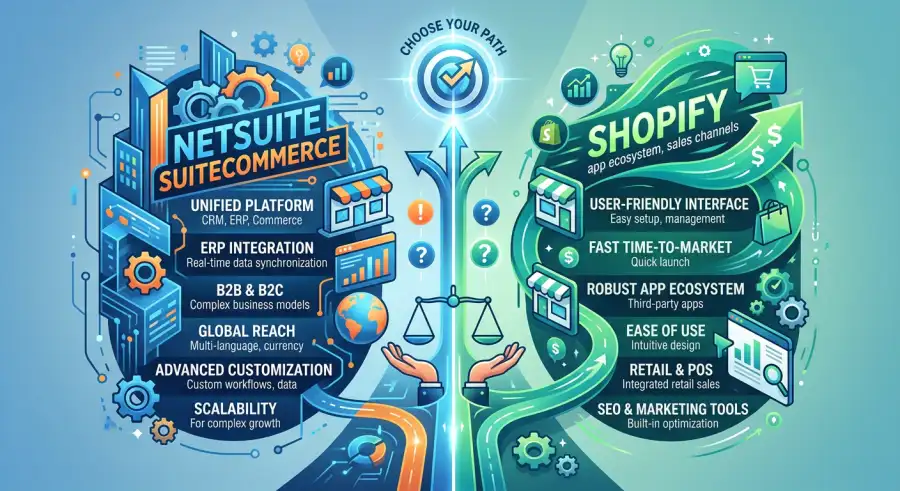
NetSuite vs. Shopify: Shopify is a choice for small to medium-sized businesses. It is easier to set up and use than NetSuite. It may lack the features and customization options of NetSuite. The right choice depends on your business's needs and the depth of integration required.
NetSuite vs. BigCommerce: BigCommerce provides an e-commerce platform. It has features. It is a middle ground between Shopify and NetSuite. It offers more customization than Shopify, but is not as complex as NetSuite.
NetSuite vs. Magento (Adobe Commerce): Magento is a platform. It is customizable. It is for large businesses with complex requirements. It can be more challenging to implement and manage than NetSuite.
What this means for you
For your business, NetSuite eCommerce integration can result in gains in efficiency, customer satisfaction, and profitability. By streamlining operations and providing a view of your business, NetSuite helps you make decisions and drive growth. Efficiency and customer experiences lead to increased sales.
Risks, trade-offs, and blind spots
NetSuite offers advantages. There are potential risks and trade-offs. The setup and implementation can be complex and time-consuming. It requires investment. Ongoing costs, including software licenses and maintenance, can be high.
Your team may need to adapt to the system. The platform might be more than what a small business needs. Assess if the return on investment justifies the costs. Are you aware of the potential hidden costs?
Main points
- NetSuite eCommerce integration connects your online store with the NetSuite platform. This creates a unified system.
- It improves efficiency by automating order processing, inventory management, and customer data management.
- SuiteCommerce and SuiteCommerce Advanced are the core e-commerce solutions. Each has features.
- NetSuite integrates with POS, accounting, CRM, and shipping systems.
- NetSuite may be ideal for medium to large businesses. The costs can be prohibitive for smaller businesses.
- Shopify, BigCommerce, and Magento are e-commerce platforms to compare with NetSuite.
Ready to take your e-commerce business to the next level? Consider NetSuite eCommerce integration. It is a tool to streamline your operations, improve customer experiences, and drive growth. To learn more about how to optimize your advertising efforts, you may be interested in exploring some of our other articles such as Performance Max vs Shopping Ads: Which is Right for You?. You can also dive into the world of social media advertising with TikTok Shop Ads: Your Fashion PPC Guide and master retargeting strategies with Retargeting Mastery in Fashion PPC.