

I Fixed One SEO Mistake: A Guide to Boosting Your Website Traffic
Uncover common SEO pitfalls and learn how to optimize your site for maximum visibility.
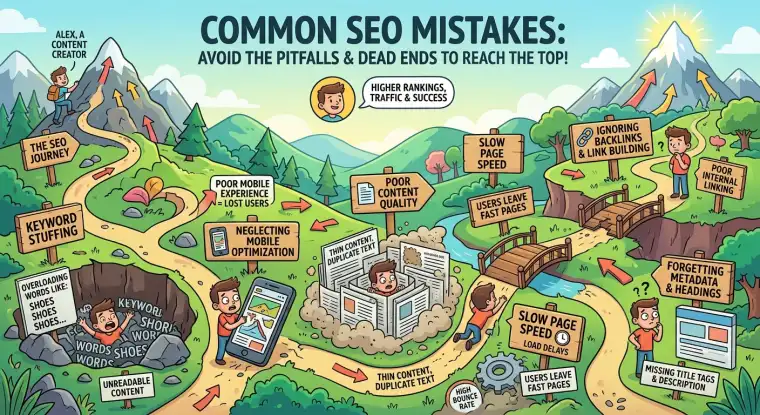
Do you feel like your website's content gets lost? Many websites have easily fixed SEO mistakes.
Imagine you could find those errors, fix them, and see your website traffic increase. This guide shows you how.
By understanding and correcting these common SEO problems, you can use your online presence to its full potential.
Search Engine Optimization (SEO) is a key part of online success. SEO is the process of improving your website to increase its visibility when people search for your business on Google, Bing, and other search engines. Making even one SEO mistake can hurt your website's ranking, organic traffic, and your business. This guide will help you find and fix SEO mistakes. You will also learn the value of a good SEO strategy for long-term success.
This article will cover common SEO errors that can hold your site back. We will explore solutions to improve your website's search engine rankings and increase organic traffic. Let's begin.
Quick navigation
What this means for you
Fixing SEO mistakes is about more than just better search rankings. It's about connecting with your audience and getting results. A well-optimized website has better visibility, which attracts more organic traffic and leads to more conversions. When you correct these errors, you are investing in your website's success.
Think of your website like a store in a busy city. If no one knows where your store is or what it sells, potential customers will not visit. SEO works like a map and a sign, leading potential customers to your online store. Fixing SEO mistakes makes sure your website appears in search results. This increases the chance that potential customers will find your content and engage with your brand.
Improving your website's SEO will result in:
- Increased Traffic: More organic traffic means more potential customers visiting your website.
- Higher Rankings: Improved rankings on search engine results pages (SERPs) lead to better visibility.
- Better User Experience: Optimized websites are easier to use. Visitors will stay longer and explore more.
- Increased Conversions: Higher rankings and a better user experience can increase the chance of conversions, such as sales or leads.
Risks, trade-offs, and blind spots
There are risks and trade-offs when fixing SEO mistakes. One of the biggest challenges is the time and effort needed to perform an SEO audit and make changes. This can be a large investment, especially for complex websites.
There is also a risk of making mistakes that hurt your website's ranking. You must stay informed about SEO best practices and test all changes. Blind spots can appear when you only use automated SEO tools or fail to adapt to changing search engine algorithms.
Staying up-to-date with SEO trends is important. What worked last year might not work today. For example, search engines focus on user experience and content quality. You should prioritize these factors over old SEO tactics. Consider how Artificial Intelligence (AI) affects your SEO approach. AI is changing fashion e-commerce marketing, and this includes SEO. AI is changing the face of the fashion e-commerce marketing landscape, and this includes SEO.
SEO needs constant monitoring, analysis, and improvement. Ignoring the changing landscape can lead to penalties from search engines or a decrease in organic traffic.
Main points
Let's look at specific SEO mistakes and how to fix them.
- Ignoring Keyword Research: Not finding the right keywords is like trying to sell ice to people who don't need it. Knowing what your audience searches for is the most important part of SEO. Use tools like Google Keyword Planner or SEMrush. Include these keywords naturally in your content.
- Poor On-Page Optimization: This involves optimizing title tags, meta descriptions, and header tags (H1, H2, etc.). These elements tell search engines about your page's content. Make sure they are optimized. Make sure your content is well-structured and easy to read.
- Lack of Mobile-Friendliness: A website that is not mobile-friendly is a major SEO mistake. Make sure your site works well on all devices.
- Slow Website Speed: Site speed affects your ranking. Slow websites frustrate users and hurt your SEO. Optimize images, use browser caching, and consider a content delivery network (CDN) to improve speed.
- Thin or Duplicate Content: Search engines penalize sites with thin or duplicate content. Create original content that provides value to your readers.
- Ignoring Technical SEO: Technical SEO covers many things, including site structure, XML sitemaps, and robots.txt files. These elements help search engines crawl and index your website effectively.
- Neglecting Internal Linking: Internal links help search engines understand your website's structure and distribute link equity. Include internal links in your content.
- Building Low-Quality Backlinks: Backlinks are important for SEO, but not all are equal. Focus on getting high-quality backlinks from trustworthy websites.
By fixing these mistakes and using a good SEO strategy, you can improve your website's visibility and drive more organic traffic. Remember, SEO is a process. Regularly monitor your website's performance. Change your strategy to stay ahead of the competition. For more information on sustainability in marketing, see top sustainability strategies.