

What Is Domain Authority? Your Complete Guide to Understanding and Improving It
A comprehensive guide to understanding and improving your website's Domain Authority.
Is your website struggling to get noticed online? You are not alone. The digital world is competitive. Understanding metrics like Domain Authority can give you an advantage.
Domain Authority is more than just a number. It shows your website's overall SEO health. It can affect your search engine rankings and online visibility.
Do you want to know the secrets of Domain Authority and improve your website's performance? Let's begin. Transform your SEO strategy.
Many metrics are used in search engine optimization (SEO). Each assesses a different part of a website's online performance. Domain Authority (DA) is a key indicator of a website's strength. It also shows its potential to rank well in search engine results pages (SERPs). This guide explains what Domain Authority is, why it matters, and how it is calculated. Most importantly, it shows you how to improve it. This guide gives you actionable insights to help your website's online presence. Domain Authority is a metric from Moz. It predicts how well a website will rank on search engine result pages (SERPs). The score ranges from 1 to 100. Higher scores mean a greater ability to rank. Domain Authority is not a direct ranking factor used by search engines like Google. It compares a website's strength to others in the same industry or niche.
Quick navigation
What Is Domain Authority? A Deep Dive
Domain Authority, as mentioned, is a metric created by Moz. It predicts how well a website will rank in search engine results. The score uses multiple factors. These include linking root domains and the total number of backlinks. This gives you a single DA score. The score helps you understand your website's ranking potential in the SERPs. A higher Domain Authority means a site is more likely to rank well. This is useful when comparing your website to competitors. Remember, this score compares your website to others. A high DA score does not guarantee top rankings. It does show a strong overall SEO profile. Track your DA score to see your SEO performance over time. This helps you find areas to improve and measure your SEO efforts.
Why Does Domain Authority Matter?
Domain Authority shows your website's overall SEO health and ranking potential. Why is it important? It helps you compare your website's performance to competitors. Compare your DA to theirs to find where your website lags. Domain Authority also helps you decide what to do in SEO. If your DA is low, focus on building backlinks and improving content. A higher DA can lead to more organic traffic. Search engines see websites with higher authority as more trustworthy. This leads to higher rankings and more clicks. It can also help you get guest posting opportunities. Many websites check your DA before accepting your content. Finally, it helps you track your progress. Check your DA regularly to see how your SEO strategies work. Adjust your approach as needed. Does your website's Domain Authority influence your business in any of these ways?
How Is Domain Authority Calculated? The Algorithm
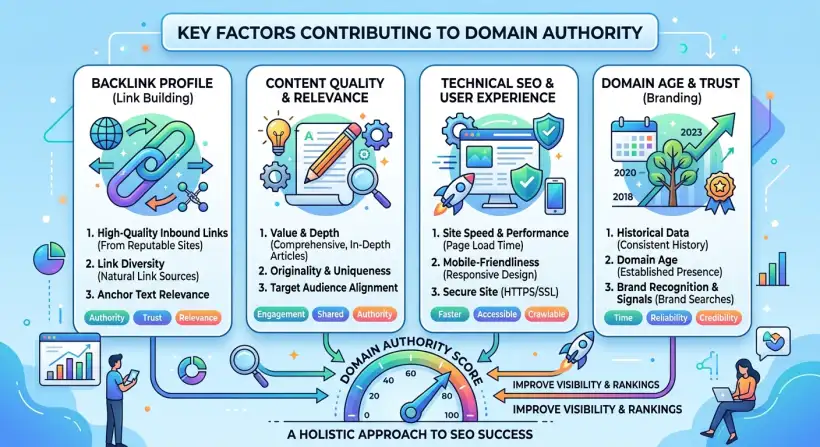
The Domain Authority calculation uses several key elements. It focuses on the quantity and quality of backlinks. Moz's exact algorithm is secret. The main factors are the number of linking root domains, the total number of backlinks, MozRank, and MozTrust. Linking root domains are important. They represent the diversity of websites that link to your content. The algorithm also considers the authority of these linking domains. Backlinks from high-authority websites have a greater impact. MozRank assesses the link popularity of a web page. It uses the number of links it receives. MozTrust evaluates a website's trustworthiness. It uses the quality of links pointing to it. The algorithm also considers other factors. These include the overall quality of content on the linking website and the relevance of the links. The Domain Authority score uses a logarithmic scale. It is harder to improve your score from 70 to 80 than from 20 to 30.
What Constitutes a 'Good' Domain Authority Score?
A 'good' Domain Authority score depends on your industry and your competitors. A score of 0–30 is poor. 40–50 is average. 50–60 is good. 60–70 is very good. 70+ is excellent. These are general guidelines. What matters most is how your score compares to your competitors. If your competitors have a DA of 60, aim for a score above that. A low DA score is normal for new websites. Your score will increase over time as you build backlinks and create high-quality content. Remember that Domain Authority compares your website to others. The higher your score is compared to your competitors, the better your chances of ranking well. Consider, what is a 'good' DA score in your specific industry?
Strategies to Improve Domain Authority
Improving your Domain Authority needs a complete SEO strategy. It must focus on building high-quality backlinks and creating valuable content. Here are some effective strategies. Focus on creating high-quality, shareable content. Content that is informative, engaging, and unique is more likely to get backlinks. Building backlinks from authoritative websites is important. Guest blogging, participating in industry forums, and contacting other website owners can help you get high-quality links. Make sure your website works well technically. Improve your site's speed, mobile-friendliness, and user experience. Optimize your website's on-page SEO. Use relevant keywords, optimize meta descriptions, and ensure a clear site structure. Check your backlinks regularly. Find and remove any low-quality or spammy links to protect your website. Use internal linking. Linking to other pages on your website helps search engines understand your content. It also improves your website's structure. This is a continuous process. It needs patience and consistent effort. Do you have a plan to use these strategies?
Risks, trade-offs, and blind spots
Domain Authority is a valuable metric. You must understand its limits. One risk is relying too much on DA as the only measure of SEO success. Consider other metrics, such as organic traffic, conversion rates, and user engagement. Also, DA is not a direct ranking factor for search engines like Google. Focusing only on DA can lead to bad SEO strategies. There are trade-offs when trying to improve your DA. Building high-quality backlinks takes time and effort. The effort to improve your DA can sometimes outweigh the benefits. DA scores can change due to algorithm updates and changes in linking. These changes do not always show your SEO performance. Some blind spots to keep in mind include DA not considering all ranking factors. On-page optimization, content quality, and user experience are equally important for SEO. DA may not fully capture these. DA also does not consider specific niches or industries. A DA score can be misleading if you do not compare your website to others in your niche. Relying on external tools can be a blind spot. The accuracy and update frequency of DA data depend on the tool provider. Before you start a new strategy, have you considered these potential risks, trade-offs, and blind spots?
What this means for you
Understanding Domain Authority and its implications can greatly affect your website's SEO strategy. Domain Authority is a useful tool for website owners and marketers. It helps to assess the overall strength of their website. It also benchmarks it against competitors. Track your DA score to see how your SEO efforts work. Find areas that need improvement. This insight helps you optimize your content strategy. Focus on topics that get high-quality backlinks. Align with your target audience's interests. This can increase organic traffic and improve your website's visibility. Domain Authority gives SEO professionals a valuable metric to assess their efforts. It helps prioritize their SEO tasks. Understanding DA helps set realistic goals. It also helps in creating effective strategies. Improving DA is ongoing. It requires effort and a complete approach to SEO. Domain Authority offers practical insights. These can help website owners and SEO professionals make informed decisions. Track progress and keep improving your SEO strategy. What will you do with this knowledge?
Main points
Here are the key takeaways from this guide:
- Domain Authority (DA) is a metric from Moz. It predicts a website's ability to rank in search engine results pages (SERPs).
- DA is calculated using several factors. These include the quality and quantity of backlinks. The score ranges from 1 to 100.
- A higher DA score shows a stronger SEO profile. It also shows a greater potential for ranking well in search results.
- DA helps you compare your website's performance to competitors. It also helps you prioritize SEO efforts.
- Strategies to improve DA include creating high-quality content, building backlinks from authoritative websites, and optimizing on-page SEO.
- You must understand the limits of DA. Consider other metrics, such as organic traffic, conversion rates, and user engagement.
- Track your DA score regularly. See how your SEO efforts work and find areas for improvement.
- Improving DA is ongoing. It needs consistent effort and a complete approach to SEO.
In conclusion, Domain Authority helps you understand and improve your website's SEO performance. Focus on creating high-quality content, building high-quality backlinks, and optimizing your website. You can improve your DA. Increase your website's visibility and organic traffic. This is a journey. Stay consistent. Keep refining your strategies. Achieve long-term SEO success. Also, check out top sustainability strategies for sustainable practices and SEO resources for further reading.