

Why Your Website Isn't Ranking: A Comprehensive SEO Guide
Find out the common reasons for low search engine rankings. Learn how to make your website more visible.
Is your website lost in the search results? You are not alone.
Knowing why your website doesn't rank is the first step. You can fix it and get the visibility you want.
This guide shows you the most common problems. It gives you ways to improve your website's search engine optimization (SEO).
Your website's ranking in search engine results pages (SERPs) is important. A higher ranking means more potential customers can find you. What if your website isn't ranking? Many things can cause this, from technical issues to content quality. This guide explores the common reasons why websites fail to rank. It also tells you what you can do about it. By understanding these issues, you can use SEO strategies. This will improve your website's visibility and attract more traffic.
This is your guide to understanding and fixing common SEO problems. This leads to better rankings. Let's start.
Quick navigation
Technical SEO Issues: The Foundation of Ranking
Technical SEO covers the parts of your website that affect how search engines look at, index, and rank your pages. Is your website technically sound? Are search engine bots able to access it? Fixing these issues is important for good rankings. Not fixing them can stop your site from showing up in search results.
A website that isn't mobile-friendly will likely struggle. Slow loading times, broken links, and bad site architecture are also big problems. Technical SEO issues include: site speed, mobile-friendliness, and site architecture.
Does your website load quickly? If your site takes too long to load, visitors will leave. Search engines will lower your rankings. Tools like Google's PageSpeed Insights can help you find and fix speed issues. Is your website optimized for mobile devices? Most people use mobile devices to browse the internet. A responsive design is important. Google's Mobile-Friendly Test can check your site's mobile compatibility. Your site structure also matters. Is your site easy to navigate? Is your content organized logically?
Content Quality: The Heart of SEO
Content is key in SEO. Good content is important for attracting and keeping visitors. Is your content valuable to your audience? Does it answer their questions and solve their problems?
Search engines give priority to content that helps users. Thin, duplicate, or irrelevant content can hurt your rankings. Focus on creating original articles, blog posts, and other content. This content should address your audience's needs and interests.
Think about these points: Is your content original? Duplicate content can confuse search engines and hurt your rankings. Does your content provide value? Create content that is informative, engaging, and useful to your audience. Is your content optimized for your target keywords?
Keyword Strategy: Finding the Right Words
Keyword research is a basic part of SEO. Your website might not target the right terms without a good keyword strategy. This means your audience won't see you. Are you targeting the right keywords?
Use relevant keywords in your content, meta descriptions, and other on-page elements. This helps search engines understand what your website is about. Avoid keyword stuffing. Using too many keywords can lead to penalties. Finding the right balance is important. Tools like Google Keyword Planner, SEMrush, and Ahrefs can help you find the best keywords.
When choosing keywords, think about search volume, competition, and relevance. Long-tail keywords (longer, more specific phrases) can be easier to rank for. They can attract targeted traffic. Make sure your keywords fit naturally into your content.
Backlinks: Building Authority
Backlinks are votes of confidence from other websites. They tell search engines that your content is valuable and trustworthy. Are other websites linking to yours?
Get high-quality backlinks from reliable websites. This is important for improving your website's authority and ranking. Earn backlinks through content creation, outreach, and building relationships. Not all backlinks are equal. Links from high-authority, relevant websites are more valuable. Links from low-quality or irrelevant sites are not as helpful.
Do not buy links or take part in link schemes. Search engines can penalize you. Create content that people want to share. This will naturally attract backlinks. You can also build backlinks by guest posting on other websites. Reach out to relevant websites to promote your content.
The 80/20 Rule in SEO
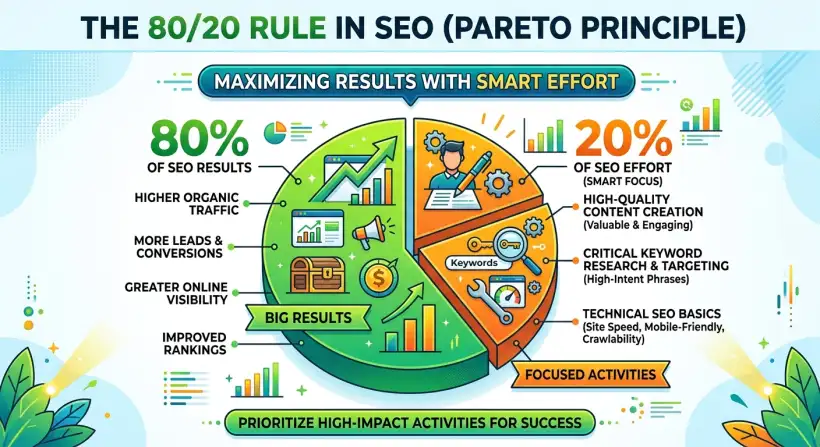
The 80/20 rule, or the Pareto principle, applies to SEO. The 80/20 rule says that 80% of your results come from 20% of your efforts. Find out where your time and resources will give you the best results. This is important.
In SEO, this might mean that 20% of your keywords bring in 80% of your traffic. It could also mean that 20% of your backlinks are responsible for 80% of your authority. Finding these key areas lets you focus your efforts more effectively. Analyzing your website data to find the most effective strategies is important.
Use analytics tools to see which keywords bring in the most traffic, which backlinks are most valuable, and which content performs best. This data-driven approach helps you make the most of your strategy. Focus on the activities that give you the best results.
For example, you might spend a lot of time on social media. But your traffic could come mostly from organic search. Focusing more on SEO would be a better choice. AI in e-commerce marketing is changing strategies in real time.
Evolving SEO: Staying Ahead of the Curve
SEO is not fixed. Search engine algorithms change often. New trends appear regularly. Are you staying up-to-date with the latest developments in SEO?
To keep your rankings, it's important to know the latest SEO updates and best practices. Follow industry blogs, go to webinars, and follow SEO experts. This will keep you ahead. Recent trends include Core Web Vitals, which is a big ranking factor. There is also the rise of voice search and mobile-first indexing.
Adapt to these changes. Use the latest SEO strategies to stay competitive. Search engines are always improving their algorithms. They want to give users the best experience. You should do the same.
What this means for you
Understanding why your website isn't ranking. Using the strategies above will improve your website's visibility. It will also bring in more organic traffic and increase conversions. In short, it helps you reach more people.
Focus on technical SEO, content quality, keyword strategy, and backlink building. This creates a website that ranks well in search results. Be patient, persistent, and adaptable. SEO is a long-term strategy that needs ongoing effort and analysis.
Risks, trade-offs, and blind spots
SEO has many benefits. But it also has risks and trade-offs. What are the possible downsides of SEO? How can you reduce them?
Relying only on SEO can make your website vulnerable to algorithm updates. A sudden change in search engine algorithms can greatly affect your rankings. Diversify your marketing strategy. Do not depend too much on one channel.
Building high-quality content and earning backlinks can take time. It also needs a lot of resources. SEO can be slow. Results may not appear right away. Have realistic expectations and be patient. You might also find unethical SEO practices. These involve bad tactics that break search engine rules. This can lead to penalties.
Main points
Here is a quick summary of the main points:
- Make sure your website has a strong technical foundation. This includes fast loading speeds, mobile-friendliness, and a clear site architecture.
- Focus on high-quality, relevant, and engaging content. This content should provide value to your audience.
- Do thorough keyword research. Find the right terms to target. Use them naturally in your content.
- Focus on getting high-quality backlinks from reliable websites. This improves your website's authority.
- Use the 80/20 rule. Find the most effective SEO strategies and focus your efforts.
- Stay up-to-date with the latest SEO trends and algorithm updates.
- Diversify your marketing strategy. Do not rely only on SEO.
- Avoid unethical SEO practices. Always follow search engine guidelines.
Use these strategies. You can improve your website's search engine rankings. You can attract more organic traffic and reach your business goals. Need more information on sustainability strategies?